Thermostats 101: What You Need to Know
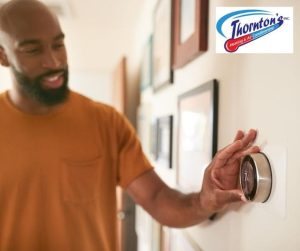
It’s hot in North Carolina and by now your air conditioning is likely running on full blast. What you may not realize is that your thermostat has a lot to do with how hot and cool your home is, your energy bill, and how efficiently your unit runs.
Thermostat Placement.
When you move into your home where the thermostat is located is probably the last thing on your mind. However, if you’re having a new unit installed or changing thermostats, placement matters. The heart of a thermostat is a built-in sensor which detects the temperature of the surrounding air. Once you set the temperature of your choosing, the thermostat evaluates if the temperature in your home is above or below your desired setting and then signals your HVAC unit when to start and stop.
Why does this matter? If your thermostat is placed in a drafty area by a door, in direct sunlight, near a lamp, or it’s obstructed by a large object then it could lead to false reading. Ideally thermostats should be placed on an interior wall away from any of the above.
Programmable Thermostats.
A programmable thermostat allows you to set a schedule for your heating and air system. If you are at work certain days of the week for set hours, it only makes sense to adjust the temperature to be more energy efficient while you are away. This is also a great option if you’re going on vacation or going to be away from home for set hours that you know in advance.
Smart Thermostats.
Just like Smart TVs, and Smartphones, Smart thermostats learn your heating and air usage in your home based on your families’ patterns and routines. They can adjust automatically if they predict you won’t be home and can even be controlled by your phone while you’re away. According to NC Sustainable Energy Association, “While these systems come with a large price tag, you will soon earn back your investment through energy bill savings that follow. Not only is this an investment that pays for itself in the long run, it’s also a worthy purchase for the convenience and environmental benefits it brings.”
The Right Temperature for Your Home.
When discussing thermostats the age-old question is always asked: “what’s the right temperature for my thermostat”? The answer, it depends. Ultimately to save you money and to keep your unit running as efficiently as possible you want to set your thermostat to the highest temperature your family is comfortable in the summer and the lowest in the winter months. The US Department of Energy recommends setting your thermostat to 78°F in the summer and 68°F in the winter. For many individuals that is not a realistic setting, however. Just keep in mind, the less your HVAC system is running, the more you can save on your electric bill and prevent wear on your unit.
Thornton’s recommends having your fan setting in the ON position during summer, which continuously circulates air in the house, and/or having multiple ceiling fans running to keep air from stratifying thus reducing the amount of time your unit cycles on and off. Following these simple steps will reduce your electricity bill. With more air movement it will feel cooler in the house and you can in most cases turn the temperature up 1 to 2 degrees, yet feel quite comfortable. The fan in your HVAC system is a continuous duty run motor which is very efficient. Less time starting and stopping again helps any motor run more effectively. An added benefit is you also increase your air filtration in your home.
Thornton’s Heating & Air Conditioning has been serving the heating and air needs of our community for over 50 years and we’re here to help you with any of your HVAC questions, including thermostats. Call us today about heating and air repairs, free estimates on new units, and yes, even for your thermostat.